
- Published
- 8 October 2026
- Last reviewed
- 8 October 2026
Start with the question
Write the uncertainty you want to explore. You may need to compare the order of information, examine wording or see whether a person can complete a sequence. These questions can require different prototype detail.
A fictional course team wants to know whether people understand the difference between two learning routes. A paper layout may support an early discussion of headings, while a navigation task may require a working sequence of screens.
Choose the necessary detail
GOV.UK describes prototypes ranging from paper sketches to interactive code. Choose the form that supports the current question. A polished visual appearance does not automatically make a prototype useful for the intended exercise.
Include enough content and behaviour for the task being examined. If a booking confirmation is out of scope, say so. Do not ask a participant to interpret a non-working button as if it were a complete service.
Explain what is being tested
Identify the prototype as a practice design and explain the activity clearly. Use fictional data and keep it separate from a live service. GOV.UK notes that prototype code is not automatically suitable for production use.
Before a session, check the route through the design and the material the participant will see. Make arrangements for access needs and use the organisation’s approved process for consent, notes and any recording.
Use the findings to refine the design
Record the observed behaviour and any limitation of the prototype. If the participant cannot finish because the prototype is incomplete, distinguish that limitation from difficulty with the proposed design itself.
Practise by sketching a fictional course-selection page. Write one question, the detail required and what is outside scope. After a permitted practice review, choose one change or a further question and explain why it follows from the evidence.
Source and practice note
The linked official guidance provides background. Examples, exercises and record layouts are original RDE learning material. Use fictional content for practice and follow your organisation’s research, accessibility and information-handling procedures.
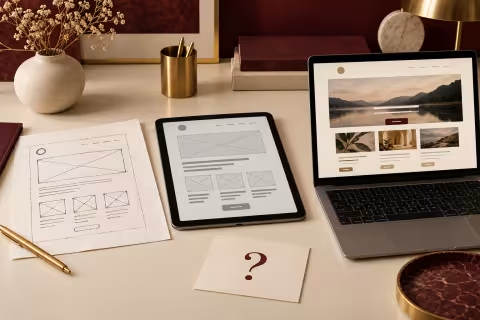
Cover image: AI-generated illustrative scene created specifically for this resource.