
- Published
- 8 October 2026
- Last reviewed
- 8 October 2026
Fictional learning scenario
This is an original RDE teaching case. The organisation, records, observations and outcomes are invented for learning. It is not a client case, testimonial or report of real results.
Context and decision to make
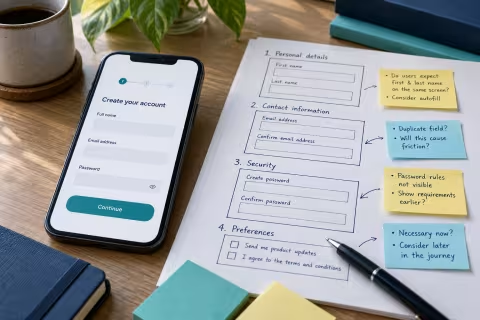
A fictional community training service receives abandoned registrations. A designer is asked to add stronger promotional text, but the team first studies whether the journey is understandable.
Evidence available in the scenario
In the first fictional moderated round, five participants attempt the same task: register interest in a beginner course using practice details. Two complete without assistance. Three hesitate at a field labelled Status because its purpose is unclear. Two of those three assume the form requires employment information before they can enquire. The notes record observed actions separately from the team’s interpretation.
Approach and interpretation
The team examines the field purpose and finds it is only needed later for a funding discussion. They also observe that the submit button says Continue even though it submits the enquiry. These are concrete design issues. The team does not interpret five sessions as a population-wide abandonment rate or attribute every real abandonment to this field.
Options and decision
Three options are considered: add promotional copy, explain all fields in a long introductory paragraph, or remove the unnecessary early question and clarify the final action. The team selects the third. The prototype explains that the form registers interest rather than enrolling someone, labels the button Send enquiry and shows a confirmation with the expected next step.
Outcome within the fictional scenario
In a second fictional round with five different participants, four complete without assistance. One cannot locate the confirmation when using a narrow mobile viewport. The team records this as a remaining issue and improves the confirmation placement before another review. The change from two to four unaided completions is a finding within two small practice rounds, not a measured doubling of live conversion.
Limitations and next checks
Participants, devices and familiarity differ between rounds. The scenario does not establish statistical significance or full accessibility. A live trial would need appropriately defined enquiry outcomes and further testing, including disabled users and people who need support. The team retains the observation notes and records what the prototype still needs to demonstrate.
Apply the case
Allow about 20 minutes. Identify the decision, extract the evidence and write down one assumption that needs checking. Separate the observed or stipulated figures from the explanation proposed by the team.
- Which details are direct observations and which are interpretations?
- Why should the form distinguish an enquiry from enrolment?
- What would be required before claiming an increase in live conversion?
Check your learning
Remove a question only after understanding its purpose. Test the complete task, including confirmation, and keep remaining problems visible.
A useful response names the unit being measured, tests the proposed explanation against the available evidence and proposes a next check that could change the decision. Avoid claiming a general result from the small fictional sample.
Use and attribution
Original educational scenario by Jefferson Otonbara Imgbi. Version 1.0, 8 October 2026. No real customer records, organisation identities or endorsements are used. Personal and internal organisational learning use permitted with author credit retained.
Further reading on the method
These sources provide general method guidance. They are not sources for the invented organisations, figures or outcomes in this case.
GOV.UK Service Manual: moderated usability testing
GOV.UK Service Manual: plan user research
Cover image: AI-generated illustrative scene created specifically for this resource.